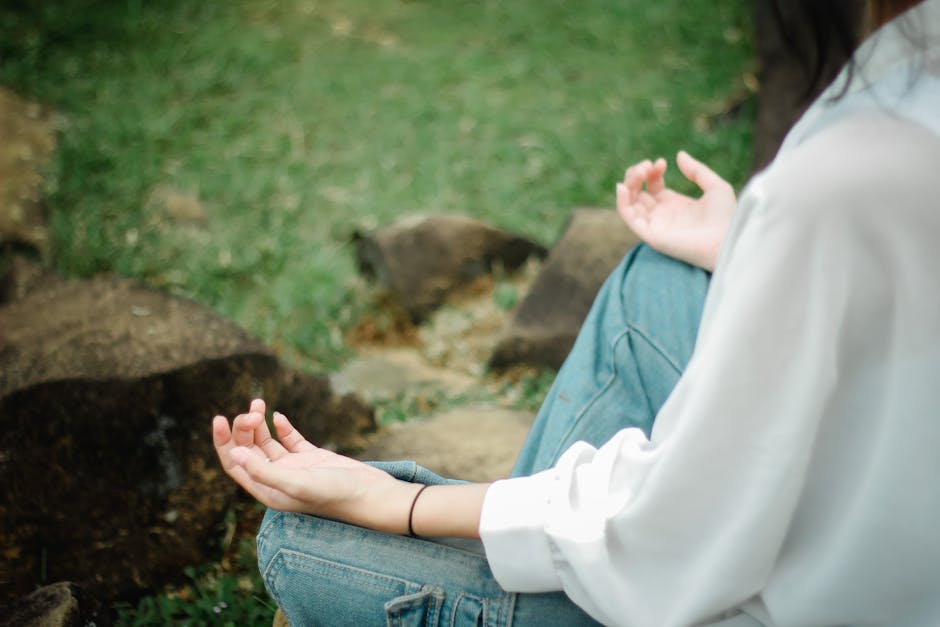
What to Do After Meditation: How to Bring Insight Into Daily Life
A lot of people know what to do during meditation.
Sit down. Breathe. Notice thoughts. Come back. Soften. Be still.
The murkier question is what happens next.
You finish a good sit. Something has opened. Your body is less defended. The usual mental noise has dropped a few notches. For a few minutes, life feels simple again.
Then you check your phone.
Or you go make coffee and get annoyed at the sink.
Or you answer one email and instantly become the same tightened version of yourself who sat down twenty minutes earlier hoping for relief.
This is where a lot of sincere practice quietly breaks down. Not because meditation failed, but because we treat the meditation cushion and the rest of life as two different worlds.
They are not.
One of the most useful lines in the Breathing Infinite topic notes says, “Each return from silence is an opportunity to manifest something new.” That gets right to the point. Meditation is not only about touching stillness. It is also about what you carry back from stillness into speech, work, relationship, and action.
So what should you do after meditation?
Not something dramatic. Usually something simpler and more demanding.
You should carry one real thing into life.
The mistake people make after a good sit
A common mistake is assuming that the purpose of meditation is the state itself.
If the sit felt peaceful, we call it a success. If it felt agitated, we call it a failure. Then we move on.
But peace during meditation is not the whole point. If your nervous system settles for twenty minutes but your speech remains sharp, your attention remains scattered, and your choices remain unconscious, then the practice has not finished moving through you.
Meditation is not just an inward event. It is a way of cleaning the lens so life can be met differently.
That means the minutes immediately after meditation matter more than many people realize.
They are a threshold.
You have just stepped out of the usual rush of self-reference. For a brief window, you are less automatic. Less gripped. Less convinced by every passing thought. In that window, something can be chosen that usually gets lost.
The old habit is to rush back into speed.
The wiser move is to ask, what is here now that was harder to feel before I sat down?
Do not ask what you realized. Ask what softened.
After meditation, people often go looking for insight in the grand sense.
Did I have a breakthrough? Did I understand something profound? Did I touch pure awareness? Did I finally figure my life out?
Sometimes meditation does bring a clear insight. More often, the shift is quieter.
Maybe your chest feels a little less armored.
Maybe you are less interested in winning an imaginary argument.
Maybe the future has loosened its grip.
Maybe you can feel sadness without making it a problem.
Maybe nothing special happened except that you are here again.
That is enough.
The question after meditation is not always, what truth did I discover? Sometimes the better question is, what softened that I can honor before I lose touch with it?
That question is humbler, but it is often more useful.
Because daily life is not transformed by collecting mystical moments. It is transformed by letting small shifts in being shape ordinary behavior.
Protect the first five minutes
If you want meditation to reach the rest of your life, protect the first five minutes after it ends.
Do not immediately open the app, check messages, or jump into planning mode if you can help it.
You do not need a second hour of incense and chanting. You just need a small bridge.
Stand up slowly.
Feel your feet.
Look around the room as if you have actually arrived in it.
Let the body know the meditation is not over in the old sense. It is changing form.
This is especially important if your days are fast. Speed erases subtlety. The calmer, quieter movements of the heart get drowned out quickly once momentum takes over.
Those first minutes are where the inner shift either begins to take root or gets traded away.
You can make this practical.
Before moving on, ask yourself three simple questions:
- What quality is most available right now?
- Where will I likely lose it today?
- How will I bring it into the next thing I do?
That is enough to make meditation functional instead of decorative.
Carry one thing, not ten
People often sabotage integration by making it too abstract.
They finish meditation and make a vague promise to be more present, more loving, more awake, more surrendered.
That sounds good, but it is too broad to survive contact with real life.
Carry one thing.
If the sit made you quieter inside, carry that into the next conversation by speaking slower.
If the sit made you more honest, carry that into the next decision by admitting what you actually feel.
If the sit made you less defended, carry that into your relationship by listening without composing your reply.
If the sit showed you how tired you are, carry that into your afternoon by canceling one unnecessary thing.
The spiritual life becomes believable when inner contact becomes outer form.
One small expression is worth more than ten noble intentions.
A lot of people are waiting for meditation to permanently change them. But most change happens more modestly. Sit by sit, one quality at a time, your life gets reorganized around what you stop abandoning.
Bring the stillness into speech first
If you are not sure where to start, start with speech.
Nothing reveals the state of your being faster than the way you talk.
After meditation, there is often a tiny gap before the usual compulsion to comment, defend, explain, joke away discomfort, or fill silence returns. That gap is precious.
Use it.
Let one conversation be less crowded.
Leave a beat before answering.
Tell the truth without adding extra force.
Notice when the body wants to interrupt.
Notice when you are about to speak from momentum instead of contact.
One of the clearest ways to carry meditation into life is to let silence remain present inside your words.
That does not mean becoming vague or passive. It means letting speech emerge from a quieter place.
People can feel the difference.
So can you.
Let the next task become the practice
Meditation does not need to be defended from daily life. It needs to enter it.
Whatever comes next can become the field.
Making breakfast. Driving to work. Answering email. Talking to your child. Folding laundry. Paying the bill you have been avoiding.
The question is not whether the next task is spiritual enough.
The question is whether you can bring the quality of attention touched in meditation into the task without insisting the task be different from what it is.
This is where practice becomes mature.
Anyone can feel peaceful in a quiet room sometimes. The real test is whether that peace can survive the dishwasher, the group chat, the awkward conversation, the long afternoon, the traffic light, the supermarket line.
Not perfectly. Just honestly.
The task after meditation is not to preserve a special state. It is to stop splitting reality into sacred moments and ordinary ones.
Do not turn insight into identity
Another trap comes after strong meditation experiences.
You feel open, clear, maybe even flooded with love. Then the mind starts building a new self-image around it.
I had a deep sit today. I am finally getting somewhere. I need to stay in this state. I should be this peaceful all the time.
Now the freshness is gone and a new performance has begun.
The point is not to become the kind of person who has beautiful meditation experiences. The point is to become a little less trapped by the person you keep trying to be.
Sometimes the best thing to do after meditation is almost invisible.
Wash the cup. Send the honest text. Do the work in front of you without complaint. Apologize faster. Walk more slowly.
In the topic notes there is a lovely prompt: “Ask as you emerge from meditation: what will I carry from the darkness into the light?”
That is better than asking how to keep the feeling going.
Because it turns the whole thing outward in a clean way.
When the meditation felt flat
Not every sit feels luminous. Some feel dull, distracted, restless, or sleepy.
That does not mean there is nothing to carry forward.
If you noticed how scattered you are, you can carry humility.
If you kept returning to the breath a hundred times, you can carry patience.
If you sat with discomfort instead of fleeing it, you can carry steadiness.
If all you touched was the fact that your mind is busy and your heart is tired, you can carry honesty.
A flat meditation can still produce a more truthful day.
In some ways, that may matter more than having a beautiful hour that leaves no trace in how you treat people.
Do not measure the value of meditation only by how elevated it felt.
Measure it by whether it made you a little more real.
A simple post-meditation practice
If you want a concrete rhythm, try this for a week.
When the meditation ends:
- Sit for one extra minute before reaching for anything
- Name the clearest quality present, such as calm, tenderness, honesty, patience, or sobriety
- Choose one place in the next hour where that quality will be expressed
- At the end of the day, ask whether you remembered
That is all.
No spiritual theater required.
You are building a bridge between inner contact and lived expression.
Over time, this changes the purpose of meditation. It stops being a private refuge you visit and starts becoming the source of a different way of moving through the day.
The real answer to what to do after meditation
After meditation, do not rush to become your old self again.
That is the simplest answer.
Give the sit somewhere to go.
Let it enter your hands, your timing, your tone, your priorities, your willingness to stay open when something small goes wrong.
Bring one thing back.
Not because life ruins meditation, but because life is where meditation completes itself.
The deepest practice is not only touching silence. It is letting silence become kindness, honesty, steadiness, and sane action.
So when you open your eyes, ask the most useful question you can:
What will I carry from this stillness into the next hour?
Then carry that.
That is enough. That is already a lot.