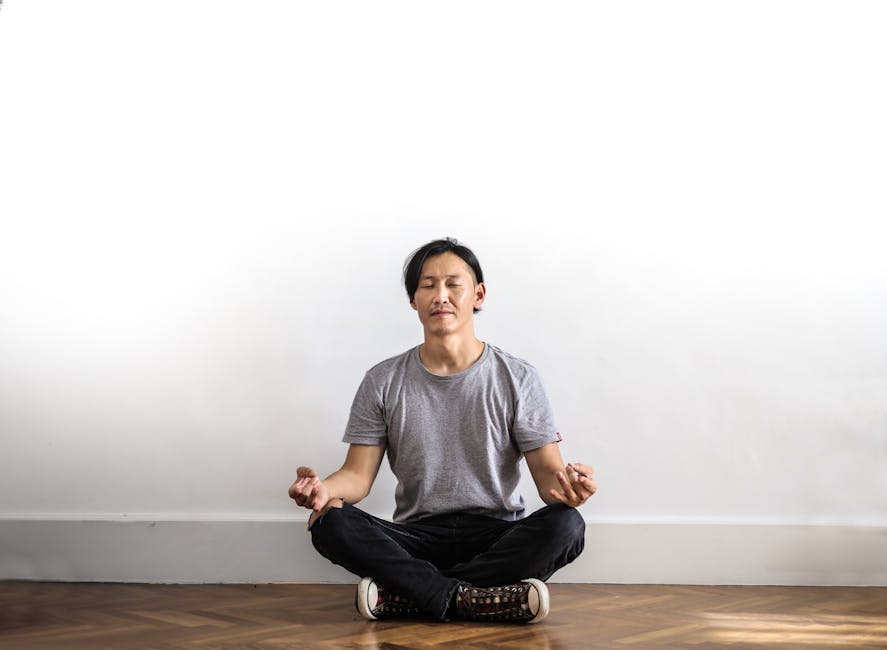
Rest as Revelation: Why Doing Less Uncovers What Effort Never Could
There’s something almost taboo about rest in spiritual circles. People trade meditation techniques like baseball cards. They compare retreat schedules, debate the merits of different practices, log their hours on the cushion like athletes tracking mileage. The entire culture around spiritual growth is soaked in effort, even when the stated goal is effortlessness.
I’m not knocking dedication. Some degree of commitment and practice has its place, especially early on when you’re building the habit of turning attention inward. But there’s a point (and almost nobody talks about this clearly enough) where effort itself becomes the obstacle.
Not the obstacle to some future goal. The obstacle to seeing what’s already here, right now, before you do anything at all.
The Effort Trap
Here’s the thing about spiritual effort: it assumes you’re somewhere you need to leave in order to arrive somewhere better. You meditate to reach a state. You practice to earn realization. You purify to become worthy of insight. Every technique contains an implicit promise: if you do this long enough and correctly enough, you’ll eventually get there.
But where is “there”? And who is the one traveling?
If you examine this honestly, you’ll find that the assumption of distance, the belief that what you’re looking for is somewhere other than where you are, is the very thing keeping the search alive. The seeker creates the gap. Not because seeking is inherently wrong, but because it presupposes that what you want isn’t present yet.
And this is where rest does something that effort simply cannot.
When effort stops, the assumption of distance stops with it. There’s no longer a trajectory, a timeline, a “me” in motion toward a “goal.” There’s just what’s here. And what’s here, it turns out, is shockingly sufficient.
What Rest Actually Means
Let me be clear about what I mean by rest, because the word gets abused.
Rest here doesn’t mean sleeping in or lounging on the couch, though those are fine. And it doesn’t mean adopting a studied spiritual laziness where you refuse to engage with life because “everything’s already perfect, man.”
The rest I’m pointing to is a specific inner gesture: the cessation of trying to modify, control, or improve your present experience. For even a few seconds, you stop managing. You stop narrating. You stop reaching for the next thought, the next insight, the next experience.
You just… stop.
Not collapse. Not check out. You let go of the steering wheel and discover, perhaps for the first time, that the car was parked the whole time. You were gripping the wheel in a stationary vehicle, feet pressed on phantom pedals, navigating a journey that existed only in your mind.
That’s rest. And it’s not passive. It takes a particular kind of courage to stop doing the thing you’ve been told your entire life you need to keep doing.
What Gets Revealed
When you genuinely rest, not as a technique, not for thirty seconds before your mind starts its next project, but as a real cessation of internal effort, something curious happens.
Whatever you were efforting toward turns out to already be the case.
You wanted peace? Peace was the background hum underneath all your frantic searching for peace. You wanted presence? Presence was the thing you were present to while you were busy trying to become more present. You wanted to know who you really are? You were it, the whole time, while you were busy constructing elaborate spiritual identities to try on.
This isn’t mystical theory. Check it right now.
Stop reading for five seconds. Don’t meditate. Don’t do anything. Don’t even try to be aware.
What’s here?
If you’re honest, something is here. Something is aware. Something is present. And you didn’t have to do a single thing to make it so. You didn’t chant, you didn’t visualize, you didn’t count breaths. You just stopped, and what was underneath your stopping was already alive, already knowing, already at rest.
That’s the revelation. It was here the entire time. Every meditation session you ever did, every retreat, every book — they all happened within this, not as steps toward it.
Why We Don’t Trust Rest
If rest reveals what effort can’t, why isn’t everyone resting? Why do we continue to stack technique upon technique, practice upon practice, endlessly approaching what’s already right here?
Because rest is terrifying to the part of you that runs on activity.
The thinking mind, the part that plans, evaluates, strategizes, and narrates, has no function in genuine rest. It can’t contribute. It can’t help. And for a mind that has spent decades believing it’s running the show, this is an existential threat. If you don’t need effort, if you don’t need the mind’s constant interference to be whole, then what is the mind for?
This is why most people, even experienced meditators, unconsciously avoid true rest. They’ll rest for a moment, then grab onto a thought. They’ll settle into silence, then immediately begin evaluating the quality of the silence. “Am I going deep enough? Is this the real thing? What should I be experiencing right now?”
That’s not rest. That’s effort wearing rest’s clothing.
The mind has a thousand strategies for simulating rest while maintaining its grip. It can relax the body while keeping the internal narration running at full speed. It can produce a kind of pleasant spaciness that feels restful but is actually just a gentler form of checking out.
Real rest is different. Real rest is what happens when even the one monitoring rest takes a break.
Rest and the Fear of Disappearing
Underneath the restlessness, if you dig down, there’s usually a fear: if I completely stop, I’ll disappear.
Not physically. But the sense of “me,” the story, the identity, the one who’s been doing all this work, feels like it will dissolve. And in a sense, it does. Not permanently, not catastrophically. But in genuine rest, the scaffolding of self-maintenance does drop away momentarily. And what’s left isn’t nothing. What’s left is awareness without a center. Knowing without a knower. Being without a story about being.
This is what the mystics point toward when they say things like “die before you die” or “lose yourself to find yourself.” They’re not being dramatic. They’re describing what happens in real rest: the false center pauses, and the actual reality, which has no center and needs none, stands revealed.
It’s the most natural thing in the world. But it looks, from the perspective of the thinking mind, like annihilation. So we keep busy. We keep efforting. We keep the spiritual treadmill running, not because it’s taking us somewhere, but because stepping off feels like stepping into the void.
And the punchline? The void is just home. It’s just what you are when you’re not pretending to be something else.
The Paradox of Practice
So does this mean all practice is useless? Should you throw out your meditation cushion and cancel your retreat?
No. And this is where it gets nuanced.
Practice can be genuinely useful, but not for the reason most people think. Practice doesn’t produce awakening. It doesn’t earn you access to something that’s currently locked away. What practice can do is exhaust the seeker. It can burn through the compulsive need to do, until what’s left is the willingness to stop doing.
Think of it like a child running around a field until they’re so tired they flop onto the grass and look up at the sky. The sky was always there. The running didn’t create it. But the running may have been necessary for that particular child to arrive at the point of lying down.
Some people need ten years of meditation before they can truly rest. Some need twenty. Some need thirty seconds. The timeline varies, but the destination is always the same: the moment when all the doing falls away and you’re simply here, seeing what was always the case.
The danger is getting attached to the running. Mistaking the practice for the point. Building an identity around being a meditator, a seeker, a spiritual practitioner. That identity becomes one more thing that needs to be maintained, one more layer of effort on top of what’s already effortless.
The greatest teachers tend to say some version of the same thing: do the practice, but hold it lightly. Use it until you don’t need it anymore. And when the invitation comes to just stop, accept.
Rest in Daily Life
This isn’t only relevant on a meditation cushion. Rest as revelation applies to how you move through your entire day.
Notice the moments when you’re gripping. When you’re trying to control a conversation, steer an outcome, impress someone, defend a position, manage your image. Notice the internal effort that goes into maintaining the show of “you.”
And then, experimentally, see what happens when you take your hands off for a moment. Not in a dramatic way. You don’t need to announce “I am now resting in the infinite” at the dinner table. Just internally, quietly, see if you can let the moment be what it is without your interference.
You might find that conversations flow better when you’re not strategizing your next response. Decisions clarify when you stop overthinking them. Relationships soften when you stop managing the other person’s perception of you.
Rest isn’t just a spiritual state. It’s a way of being in the world that lets reality show up without your fingerprints all over it. And reality, left unmanaged, turns out to be far more intelligent, far more beautiful, and far more sufficient than anything your planning mind could construct.
The Deepest Truths Are Not Achieved
Here’s the line that keeps coming back to me, the one that changed everything:
Effort discovers the finite; rest reveals the infinite.
Think about that. Everything effort can reach is bounded. Every state you can produce through technique will pass. Every experience you can generate through practice is, by definition, temporary, because it required conditions to arise. What requires conditions to appear will disappear when conditions change.
But what’s present in rest, what’s revealed when all the effort drops, isn’t conditional. It’s not a state. It’s not an experience in the usual sense. It’s the unchanging ground in which all states and experiences come and go. You can’t produce it because you can’t un-produce it. You can’t get closer to it because you’re never away from it.
All you can do is stop the activity that obscures it. And even that “stopping” isn’t really something you do. It’s something that happens when you finally get tired enough to admit that you were never getting anywhere.
Your being requires no maintenance. Only your self-image does.
When the self-image takes a break — even for a breath — what’s left is the most obvious, intimate, unremarkable, and simultaneously staggering truth: you are already what you were looking for. You always were. And no amount of effort was ever going to produce what’s already the case.
A Simple Experiment
I want to end with something practical, because all of this is useless if it stays conceptual.
Right now, wherever you are, try this:
Don’t meditate. Don’t do anything special. Don’t try to relax or concentrate or be present or aware. Instead, simply stop any inner effort you can detect. Even for ten seconds.
Notice if you’re subtly trying to have a particular experience. Stop that.
Notice if you’re monitoring whether the experiment is “working.” Stop that too.
Notice if you’re waiting for something to happen. Stop.
What’s left when you stop everything?
Not nothing. Something very quiet, very ordinary, very present. It doesn’t announce itself. It doesn’t feel like a cosmic revelation. It feels like the most obvious thing in the world — so obvious you overlooked it while you were busy looking for something more spectacular.
That’s it. That’s the revelation rest offers.
Not fireworks. Not transcendence. Just this — unhurried, unforced, already complete.
And it was here the whole time.