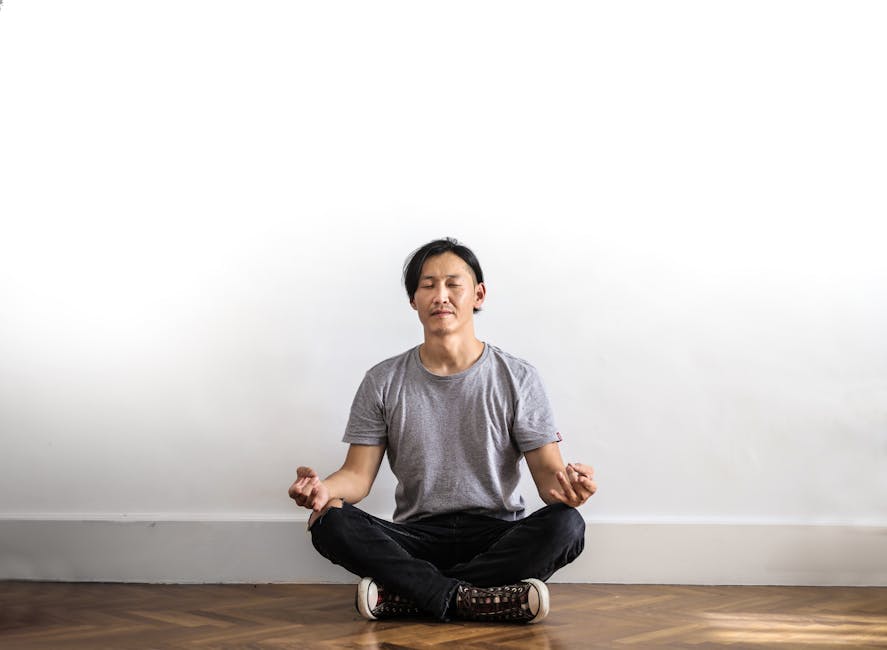
The Pause Between Breaths: Finding the Still Point Where Everything Changes
You’ve probably never paid close attention to the moment between your inhale and your exhale. It’s a tiny space. Maybe half a second. Your lungs are full, and then something shifts, and the air starts flowing back out. It happens twenty thousand times a day without you thinking about it once.
But that sliver of time between the in-breath and the out-breath isn’t nothing. It’s not dead space, not a mechanical delay while the body switches gears. Contemplatives across every tradition have pointed to this gap as something remarkable. Something alive.
T.S. Eliot called it “the still point of the turning world.” The yogic traditions call it kumbhaka. Christian mystics spoke of a moment of suspension where the soul rests in God. And if you’ve ever caught yourself in that pause, even by accident, you know there’s something to it. A quiet flash of being that’s different from either the inhale or the exhale. Neither coming nor going. Just… here.
This isn’t mystical hand-waving. You can find it for yourself in the next thirty seconds if you’re willing to pay attention. And what you find there might reframe your entire understanding of what meditation is actually for.
Why Nobody Talks About the Pause
Most meditation instruction focuses on the breath as movement. Follow the inhale. Follow the exhale. Notice the sensation at the nostrils, or the rise and fall of the belly. The breath becomes an anchor, something to come back to when the mind wanders.
That’s useful. It works. But it treats the breath as a continuous stream, and it skips over the most interesting part.
The pause gets overlooked because it’s barely there. It’s not dramatic. It doesn’t announce itself. And in a culture that values doing and moving and producing, a fraction of a second of absolute stillness seems like the least important thing you could focus on.
But consider what’s actually happening in that gap. The body has finished one action (inhaling) and hasn’t started the next (exhaling). For just a moment, nothing is being done. No effort is being applied. No direction has been chosen. It’s pure potential, unresolved and open.
The saints recognized something here. They saw that in this threshold between actions, transformation can happen without effort. Not through willpower. Not through concentration. Just through the natural rest that occurs when movement pauses.
What the Pause Actually Feels Like
If you slow down your breathing right now (not forcing it, just allowing a slightly longer, more deliberate rhythm) and bring your attention to the top of the inhale, you’ll notice something peculiar.
There’s a moment where you’re neither breathing in nor breathing out. The lungs are still. The diaphragm is still. And if you’re attentive enough, you’ll notice that your mind gets still too. Not because you forced it quiet, but because the body’s pause creates a natural opening.
In that gap, thinking often suspends on its own. Not permanently. Not dramatically. But for a beat, the constant narration just… stops.
And what’s left?
Awareness. Knowing. Presence. Whatever word you want to use for the fact that something is still wide awake even when thinking has paused.
This is what makes the breath gap so interesting. It’s not that you achieve some special state. It’s that you get a glimpse of what’s always here underneath the noise. The pause reveals what the movement was covering up.
It’s as if the breath is a wave, and the pause is the ocean becoming visible between waves. The ocean was always there. You just needed the wave to recede for a moment to notice it.
The Still Point Is Not a Place
When people hear about this practice, they sometimes try to freeze the pause. They hold their breath at the top and squeeze their attention into the gap, trying to extend it or deepen it by force. This never works. You just end up tense and slightly dizzy.
The still point isn’t something you can grab. It’s more like a doorway you pass through. You don’t camp in a doorway. You enter it, and something opens.
The yogic tradition understood this. In pranayama, kumbhaka (breath retention) is practiced not as an end in itself but as a way of sensitizing yourself to what the pause contains. The practice loosens your grip on the constant need to do something, to keep moving, to keep breathing as if your identity depends on it.
And here’s where it gets interesting. In the pause, the usual sense of yourself as a person located in time softens. Normally, you feel like you’re someone moving through a sequence of moments. Past behind you, future ahead, present happening to you. But in the breath gap, that structure wobbles.
You’re not held in time. Time is held in you.
That sounds abstract until you experience it. When thinking pauses and the breath is still, there’s no sense of time passing. There’s just open awareness. And everything that seems to happen “in” time, including your breathing and your heartbeat and the sounds in the room, all of that appears within this awareness.
The pause gives you a taste of your actual relationship to time. Not that you’re a creature trapped in its flow, but that you’re the space in which the flow occurs.
A Practice for the Breath Gap
This is simple enough to do right now. You don’t need a cushion or a timer or a special room.
Sit comfortably. Let your breathing be natural for a few rounds. Don’t try to control it.
Then, very gently, begin to notice the top of the inhale. The place where the in-breath completes and the out-breath hasn’t begun. Don’t hold your breath. Just notice.
Stay with this for a few rounds. Inhale. Notice the pause. Exhale. Don’t try to extend the pause or make it into something. Just give it attention.
After a few minutes, you might notice the pause starting to deepen on its own. Not because you’re forcing it, but because attention has a way of expanding what it touches. The gap might feel slightly longer, slightly more spacious.
In this space, let yourself rest. Don’t look for anything. Don’t try to feel blissful or peaceful or spiritual. Just be present in the pause as it naturally occurs.
If thoughts arise, that’s fine. Let them. The pause will come around again with the next breath. You always get another chance.
Over time, you might notice that the stillness you find in the breath gap starts to bleed into the rest of your breathing. The inhale becomes quieter. The exhale becomes softer. The whole cycle of breathing starts to feel less like mechanical pumping and more like a gentle rhythm within a much larger stillness.
That’s when the practice starts to get interesting.
What the Pause Teaches
There are a few things you can learn from lingering in the breath gap that are hard to learn any other way.
Nothing is wrong with not-doing. We’re so conditioned to equate stillness with laziness or stagnation that we forget how to rest without guilt. The pause teaches your nervous system that it’s safe to stop. That you don’t collapse when effort ceases. That something continues, something aware and alive, even when you’re not doing anything at all.
Transformation doesn’t require force. Some of the most significant shifts in understanding happen not through effort but through natural openings. The pause between breaths is one of those openings. You don’t push through it. You soften into it. And what needs to change, changes.
New beginnings arise from stillness. Every exhale is a new beginning. And every exhale is born from the pause. The gap is where the next movement gathers itself. Not through planning or deciding, but through a kind of organic readiness.
If you’re stuck on a problem, if you’re caught in a loop of anxiety or overthinking, the breath pause is a reset button. Not because it solves anything directly, but because it interrupts the momentum long enough for something fresh to emerge.
This is what the Breathing Infinite framework points to: the full cycle of breath as a mirror for the full cycle of conscious existence. The inhale as return to source. The exhale as expression into form. And the pause between them as the threshold where something invisible becomes something real.
You don’t have to buy into any particular philosophy to notice this. You just have to breathe and pay attention.
The Pause Is Always Available
One of the beautiful things about this practice is that it doesn’t require any special conditions. You breathe all day. The pause happens all day. Which means the doorway to stillness is opening twenty thousand times between sunrise and sunset.
You can find it in a meeting. On a train. While washing dishes. In the middle of a conversation, if you’re subtle about it. The breath gap doesn’t require you to close your eyes or sit in silence. It only asks you to notice.
And each time you notice, you touch something that the noise usually covers. A quiet, unmarked depth that has nothing to do with your circumstances and everything to do with what you are.
Over time, with practice, the distinction between the pause and the rest of your life starts to thin. Not because you’re constantly holding your breath, but because the stillness you keep finding in the gap starts to become familiar. You start recognizing it everywhere. In the space between words. In the moment before a decision. In the gap between hearing a sound and reacting to it.
The pause was never just about breathing. It was a training ground for recognizing the stillness that runs underneath everything.
What Emerges from Stillness
There’s a temptation to make this practice goal-oriented. To use the breath gap as a technique for relaxation or stress management or improved focus. And honestly, it does help with all those things. But that’s not its deepest gift.
What the pause ultimately reveals is that you don’t need to add anything to this moment. The gap between breaths is complete as it is. Nothing is lacking. Nothing needs to happen. And from that completeness, whatever is actually needed arises on its own.
This is hard to convey in words because it sounds passive. Like you should just sit around and wait for life to happen. That’s not it. It’s more like discovering that your actions become clearer and more effective when they arise from rest rather than from anxiety.
A breath that starts from genuine stillness is different from one that’s rushed. An action that emerges from the pause carries a different quality than one driven by compulsion. And a life that includes regular contact with this gap, even for fractions of a second, develops a rhythm that feels more natural and less forced.
The pause between breaths isn’t a technique for getting somewhere. It’s a reminder of where you already are.
Try It Now
You’ve been reading for a few minutes. Your mind has been active, processing words and ideas. That’s fine.
Take one breath. A slow, full inhale. And at the top, pause. Don’t hold. Just notice.
Be there for a moment.
Then let the exhale come when it’s ready.
Whatever you find in that gap is yours. No teacher can give it to you. No book can describe it adequately. But your breath delivers you there, free of charge, thousands of times a day.
All you have to do is notice.